In short
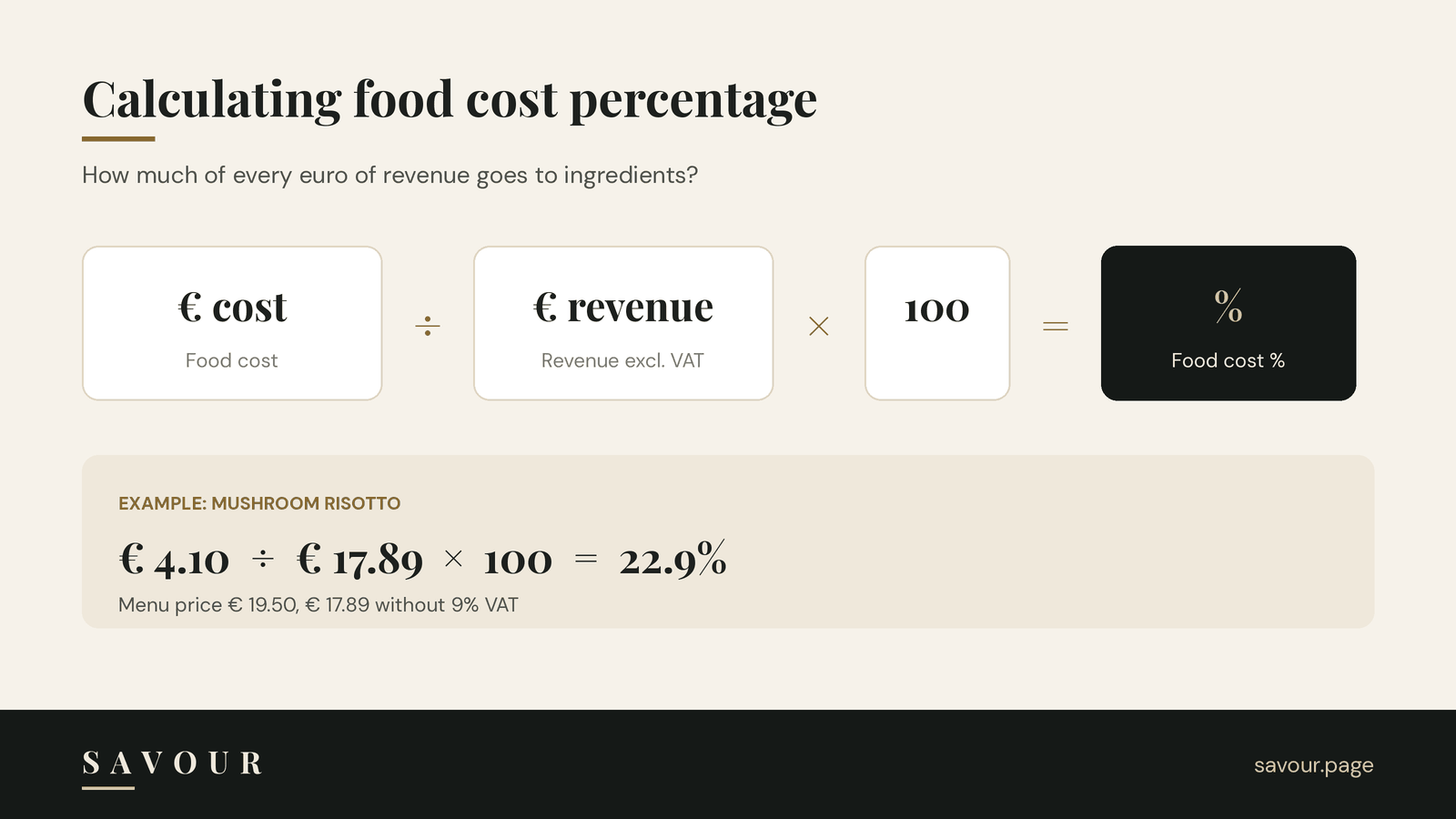
- Food cost percentage = ingredient cost ÷ selling price excluding VAT × 100.
- Calculate each dish with its yield: what you trim off, you pay for too.
- Over a month: opening stock + purchases − closing stock. The gap with what it should have cost shows where money leaks away.
What is food cost?
Food cost is what you spend on the ingredients of what you sell. You can express it in euros, or as a percentage of revenue. That percentage is the number you steer by: it shows how much of every euro you earn goes straight to ingredients.
A dish with € 4 of ingredients is fine at a selling price of € 16, but a problem at € 9. Always calculate with the price excluding VAT: the VAT isn’t yours.
Calculating food cost per dish
The cost of one plate is the basis of everything. This is how you work it out:
- List every ingredientWith the quantity per portion. Don’t forget garnish, sauce and oil: small items add up.
- Look up the purchase pricePer kilo, litre or piece, as you actually pay it.
- Correct for yieldCleaning, peeling and boning cost weight. If you get 850 grams of usable mushrooms from a kilo, your yield is 85% and the real price is the purchase price ÷ 0.85.
- Add it all upThat is your cost per portion.
- Divide by the selling price excluding VATTimes 100, and you have the food cost percentage.
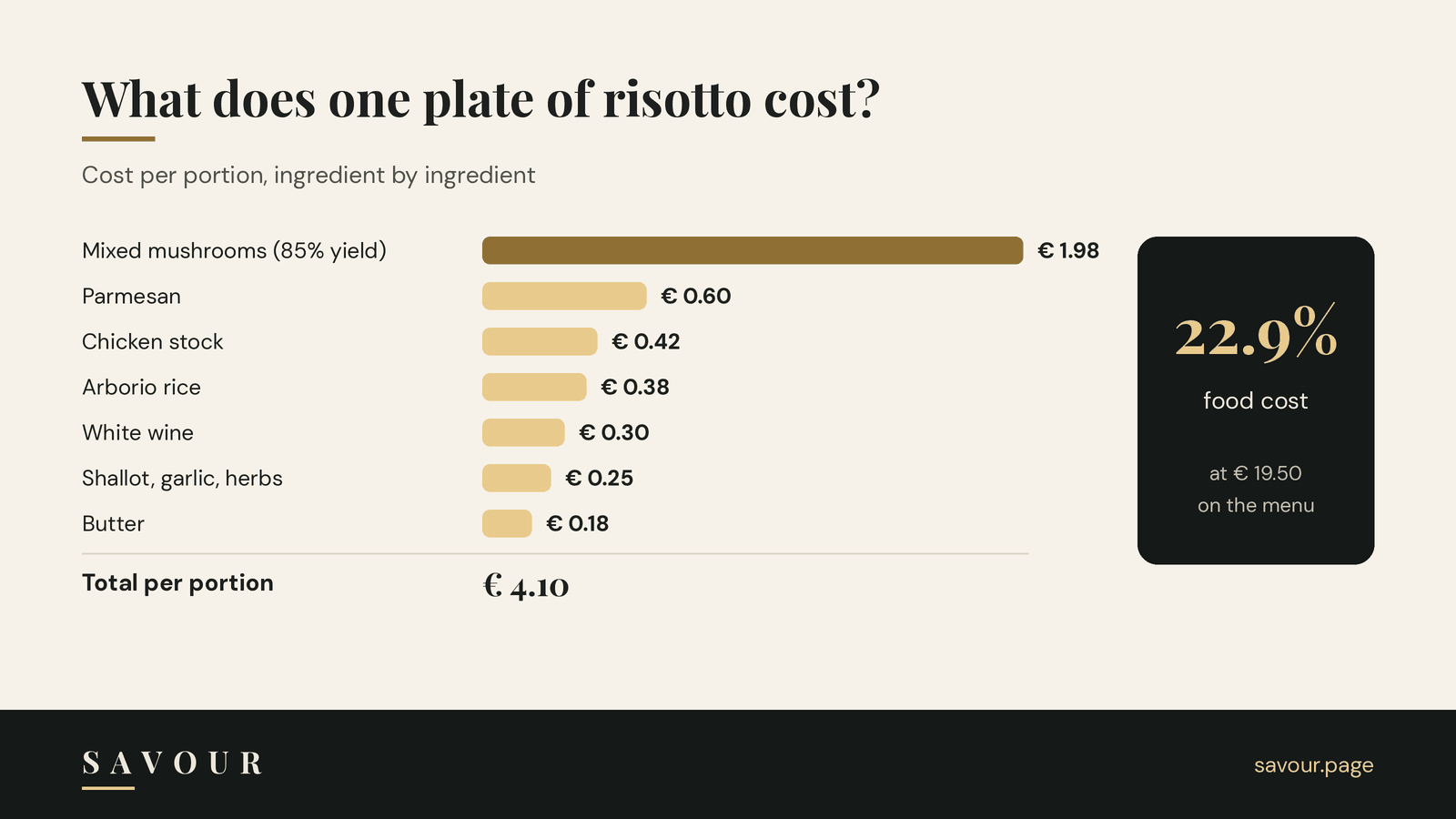
| Ingredient | Per portion | Purchase price | Yield | Cost |
|---|---|---|---|---|
| Mixed mushrooms | 120 g | € 14.00/kg | 85% | € 1.98 |
| Parmesan | 25 g | € 24.00/kg | 100% | € 0.60 |
| Chicken stock | 350 ml | € 1.20/l | 100% | € 0.42 |
| Arborio rice | 90 g | € 4.20/kg | 100% | € 0.38 |
| White wine | 50 ml | € 6.00/l | 100% | € 0.30 |
| Shallot, garlic, herbs | – | – | – | € 0.25 |
| Butter | 20 g | € 9.00/kg | 100% | € 0.18 |
| Total | € 4.10 |
Worked example: mushroom risotto. The amounts are an example, not an average.
Your actual food cost over a month
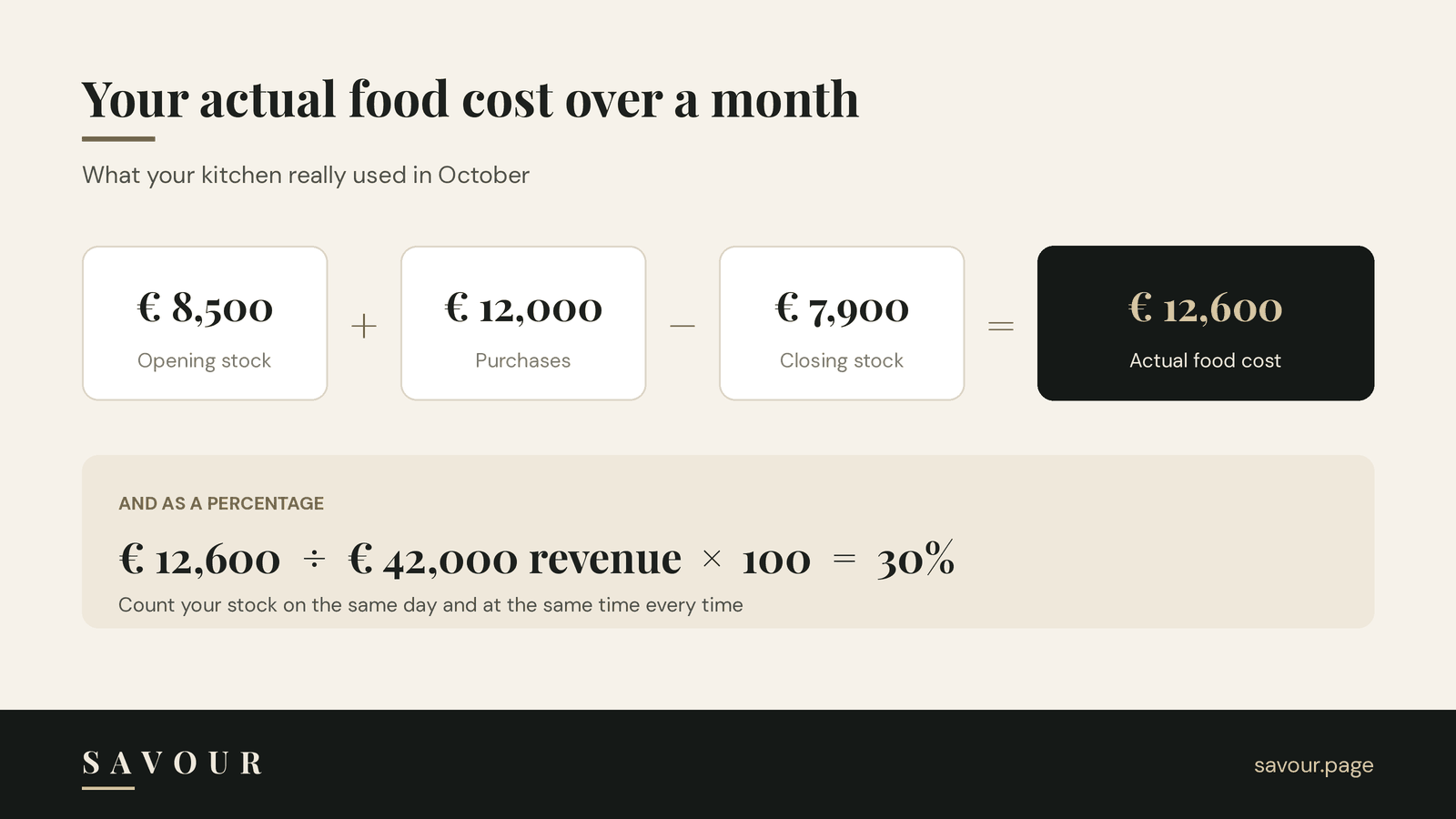
The cost per dish is the theory. What your kitchen really uses only shows over a fixed period, such as a week or a month. You need three numbers: your stock at the start, what you bought and your stock at the end.
Opening stock + purchases − closing stock = actual food cost. Divide that by the revenue excluding VAT for the same period and you have your actual food cost percentage.
Theory versus reality
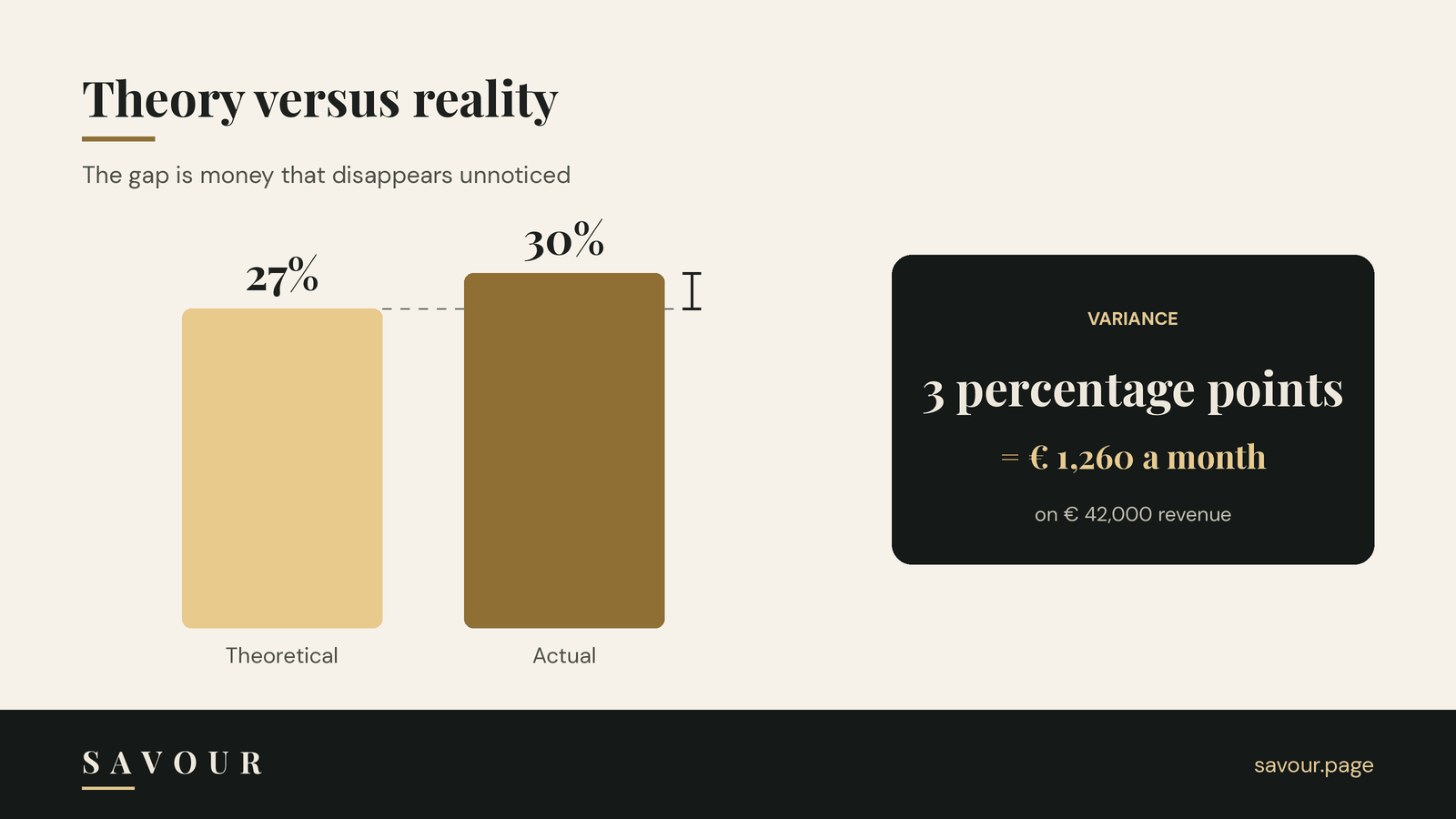
Add up the cost of every dish you sold and you get your theoretical food cost: what it should have cost. The gap with your actual food cost is called the variance. The closer to zero, the better your kitchen is under control.
If your theoretical food cost in October was 27% and your actual one 30%, then 3 percentage points disappeared unnoticed. On € 42,000 of revenue, that is € 1,260 in one month.
- Waste: what goes out of date or goes wrong.
- Portions too large: ten grams extra per plate adds up.
- Deliveries: weight, quality or price doesn’t match the order.
- Outdated recipes: the cost was worked out with old prices or an old version of the recipe.
What is a good food cost?
There is no magic number: a place with expensive produce sits higher than a lunchroom or pizzeria. For comparison: in 2024 Dutch restaurants spent an average of 31.1% of their revenue on purchases, food and drink together (CBS). More figures in What does a restaurant cost?.
Once you know your own target, you can work back to a selling price: cost per portion ÷ target percentage = selling price excluding VAT. Then check whether that price suits your guests and your competitors. A formula is a starting point, not a verdict.
Cost of the risotto: € 4.10
Target: 25% food cost
4.10 ÷ 0.25 = € 16.40 excluding VAT
With 9% VAT: € 17.88, rounded to € 18 on the menu
How to lower your food cost
Most of the gain isn’t in buying cheaper, but in letting less leak away.
- Work with fixed recipes. Cooking by feel means a different dish at a different cost every time. See also Standardised recipes.
- Keep your purchase prices up to date. A recipe costed with last year’s prices lies to you.
- Weigh and portion. Especially meat, fish and cheese.
- Keep a waste log. What goes in the bin, and why? After a few weeks you see patterns.
- Use the whole product. Peel, bones and trimmings become stock, sauce or staff food.
- Check deliveries. Weight, quality and the price on the invoice.
Food cost starts with your recipes
Every calculation above stands or falls with correct recipes that everyone in the kitchen follows the same way. That is what Savour is for: one clear recipe library, shared with your brigade, so every cook makes the same dish at the same cost.
And soon Savour will do the maths for you too: the food cost calculator works out the cost of a dish or your whole menu from your own recipes, with your supplier’s prices.
The amounts in this article are a worked example. For your own kitchen, always calculate with your own prices.